

[October 2026] Proudly Australian – from design to delivery
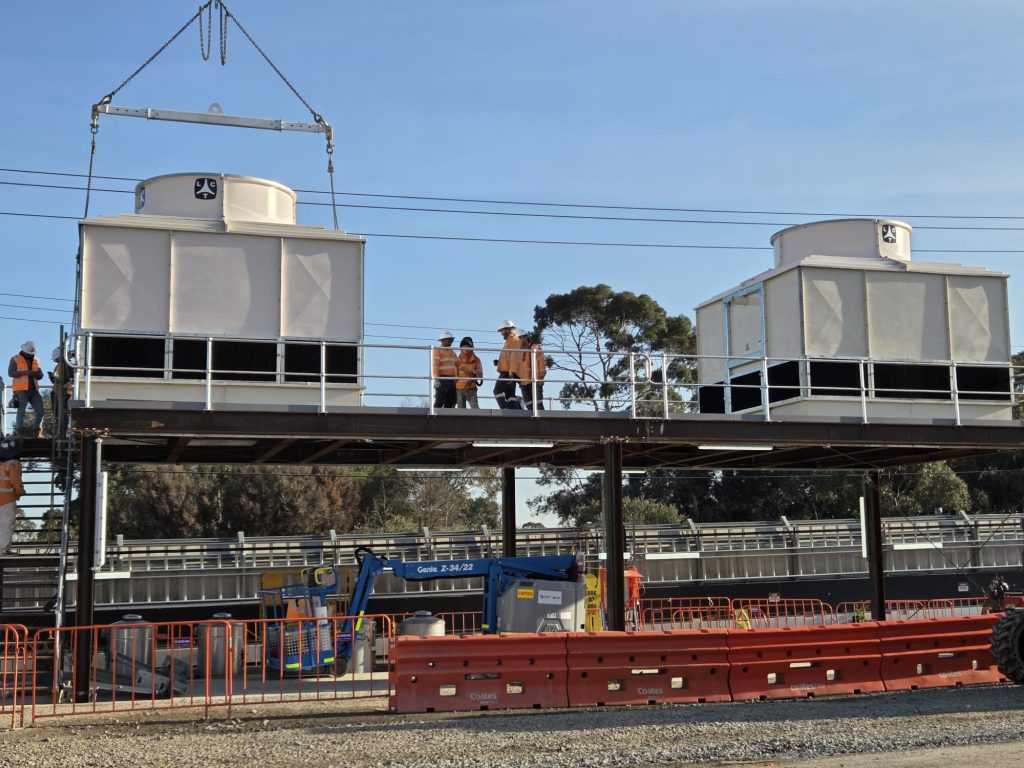
Lakeside Cooling Towers has just completed the supply and delivery of the latest two cooling towers for the Suburban Connect JV, supporting the Suburban Rail Loop (SRL) tunnel boring works in Melbourne.
What makes this delivery particularly special is that these cooling towers have been designed and manufactured in Australia by an all-Australian cooling tower manufacturer.
For nearly seven decades, Lakeside has continued to design, manufacture and supply specialised induced-draft cooling towers for demanding Australian and international applications.
Australian design. Australian manufacturing. Australian engineering. Two more Lakeside cooling towers now ready to do their job for the Melbourne TBM.
[June 2026] MELBOURNE, AU – History isn’t just made; it is cooled
LAKESIDE COOLING TOWERS FORGES ANOTHER LEGENDARY CHAPTER IN VICTORIA’S TRANSPORT REVOLUTION!
History isn’t just made; it is cooled, engineered, and built to last by
Lakeside Cooling Towers that proudly declares its next monumental victory, cementing
another lakeside cooling tower legacy in contributing to Melbourne’s rail system!
FROM THE DEPTHS OF WEST GATE TO THE FRONTIERS OF THE FUTURE
Lakeside’s relentless journey to reshape Victoria’s transit landscape began with the initial
growing pains, and precision. WEST GATE TUNNEL BORING was Lakeside’s initial,
contribution to Melbourne’s ambitious transport enhancement. When the city demanded
unstoppable subterranean development, Lakeside answered the call.
Lakeside is thrilled to announce its explosive new contract with Suburban Connect, the
mega-consortium awarded a staggering $3.6 billion contract by the Victorian Government to
construct the colossal SRL East Tunnels South package for Melbourne’s iconic Suburban
Rail Loop!
ALIGNED WITH GLOBAL INFRASTRUCTURE TITANS
Lakeside Cooling Towers joined forces with a powerhouse triumvirate of global engineering royalty:
- CPB CONTRACTORS: The undisputed titans of Australia and New Zealand construction. A member of the prestigious CIMIC Group with a legendary track record of delivering mega-infrastructure, including Melbourne’s West Gate Tunnel and North East Link.
- ACCIONA: The global vanguard of sustainable infrastructure. Headquartered in Spain with a massive, unstoppable footprint across Australia, mastering mega-projects like the Sydney Metro West and the Western Harbour Tunnel.
- GHELLA: The internationally renowned Italian masters of complex underground excavation. Armed with a historic Australian track record delivering premier tunnelling packages for the Sydney Metro and Brisbane’s Legacy Way.
THE EPIC SCOPE: SUBURBAN RAIL LOOP EAST (PACKAGE C)
Together with Suburban Connect, Lakeside is backing the delivery of Package C, a breathtaking engineering feat that will transform how Melbourne moves forever. We are fueling the infrastructure required for: - 16 Kilometers of Twin Rail Tunnels slicing through the earth between Cheltenham and Glen Waverley, destined to be the longest tunnels in Victoria!
- 55 Critical Cross Passages and two massive tunnel portal structures.
- Massive Underground Station Boxes excavated at the bustling hubs of Clayton and Monash.
- The State-of-the-Art Southern Train Stabling Yard in Heatherton.
COOLING THE TWIN BEATING HEARTS OF KINGSTON ROAD
The first spectacular stage of Victoria’s Suburban Rail Loop, SRL East, runs from
Cheltenham to Box Hill. At the absolute epicenter of this revolution are two highly
interconnected, industrial powerhouses located along Kingston Road in Melbourne’s south-
east, and Lakeside’s legacy will be felt across both!
The Southern Stabling Site (Heatherton), The Operational Heart
Rising from a former landfill site on Kingston Road, this permanent facility is the nerve
centre of the entire SRL East line.
The Mission: Once open, this high-tech yard will stable, clean, and maintain the next-
generation fleet of SRL trains. It will also house the ultra-advanced Operational
Control Centre.
The Engineering: Here, underground tracks will spectacularly climb to ground level
via eastern and western tunnel portals, creating a seamless transition from the abyss to
the surface.
The Alex Fraser Site (Clarinda), The Tunnelling Hub
Located just east of the stabling site at the Materials Recycling Facility, this site represents a masterclass in community-first engineering.
- The Mission: To protect local residents from noise and surface disruptions, plans were brilliantly pivoted to launch all four massive Tunnel Boring Machines (TBMs) from this industrial stronghold!
- The Tunnelling Force: Two TBMs are deployed north toward Glen Waverley, and two west toward Cheltenham. This bustling hub hosts essential support facilities, including twin tunnel access structures and advanced soil treatment facilities.
THE ULTIMATE SYNERGY
While the Southern Stabling site stands ready as the permanent sanctuary for train
maintenance and operations, the heavy, earth-shattering excavation work has been
strategically unleashed next door at the Alex Fraser site, the ultimate launchpad for the
project’s historic tunnelling phase.
Wherever the machinery cooling is required, wherever the earth is moved, and wherever
precision cooling is required to keep the wheels of progress turning, Lakeside Cooling
Towers is there.
WE DON’T JUST KEEP PACE WITH THE FUTURE. WE COOL IT.
.
[November 2024] Another Lakeside Carbon Capture Project
This direct air capture (DAC) technology is an advanced system capable of capturing
CO2 from the air with very low energy consumption and high scalability potential.
The project has been funded and supported through various schemes by the Australian
Government and the Department of Energy, Environment, and Climate (DCCEEW) to achieve
net-zero emissions milestones.
The technology is owned by MK Collect and the University of Melbourne, designed
by Innaco, and constructed by Protex Water.
The successful execution by Innaco and Protex Water highlights their engineering
expertise and innovation in developing new processes.

.
Lakeside has supplied Sami Bitumen with their new specialised asphalt production in Melbourne.

[July 2023] Dunnstown spring water and non-dairy milks
Lakeside Cooling Towers serving a Dunnstown plant-based paper-packaged spring water, and non-dairy milks manufacturing.

[May 2023] Westgate Tunnel Boring completion.
Westgate TBM, cooled by Lakeside Cooling Towers completed its job. [Read more here: “Machines Break Through on Huge Melbourne Road Tunnel“]

[May 2023] Gospel Whisky production requirements
Lakeside provided Melbourne’s Gospel Whisky, judged best whisky, with their cooling production requirements.

[August 2022] Lakeside has relocated
Our new address: Factory2 /3-5 Natalia Avenue Oakleigh South Victoria 3167.
[August 2022] Westgate Tunnel’s Works progress
Lakeside’s cooling towers working behind the scene to cool the biggest tunnel boring machines in the southern hemisphere already 35% through their journey under Melbourne’s inner west. Watch the clip…
[August 2022] When Air Cooling Does Not Work
Dry coolers require large surface areas and have relatively high energy consumption, even with higher water temperatures, in comparison to the better energy efficiency and significantly smaller surface areas of evaporative coolers/ cooling towers.

Evaporative cooling/ Cooling Towers can achieve lower cooling water return temperatures, only 3-5°C above the design wet bulb temperature, enabling lower condensing temperatures. Each 1°C reduction in condensing temperature equals 3% energy saving for the chiller.
The below picture depicts two attempts made to correct the failed performance by firstly replacing the fans with more powerful units. This having failed to rectify the problem; a water spray system was installed below the air intake to provide additional cooling.
The resultant added water cooling is typically a cooling tower’s performance principle but in this instance is not being recycled [as do cooling towers]. It is water wasting.
Notwithstanding wasting water; the water used has no chemical treatment against Legionella; a cooling tower standard application; and may disperse into the atmosphere the potentially prevalent bacteria in the water hence a potential health issue.
[November 2021] Infrastructure Investment Program
The Australian Government is investing $110 billion over 10 years from 2021-22 in land transport infrastructure across Australia through its rolling infrastructure pipeline, most of which is under the Infrastructure Investment Program.
This program is part of the Government’s broader strategy to bust congestion, better connect our regions, meet our national freight challenge, get Australians home sooner and safer, and build a stronger and more resilient Australia.
This $110 billion investment forms part of the Government’s plan to secure a world-leading economic recovery from the COVID-19 pandemic.
Lakeside Cooling Towers is pleased to take part in the Australian government’s Infrastructure Investment Program with the supply of its cooling tower and associated equipment to produce specialized bitumen for roads surfacing.

To read more please visit: https://investment.infrastructure.gov.au
[November 2021] Energy & Emissions Reduction Success.
Our world’s existential necessities which include CO2 emissions and depletion of our carbon absorbing forests and jungles, is being highlighted at the G20 summit in Rome and followed by the COP26 Glasgow climate change conference.
We are very pleased to see our vision for Lakeside Cooling Towers [LCT] being finally acted upon by the world at large. Since 1992 LCT has stopped using timber for cooling tower building as part of its determination to reduce degradation of our environment.
It is also very pleasing to see many of our clients’ commitment to our environment by selecting LCT’s energy efficient Australian made cooling towers.
Santos one of our clients, has successfully tested last year 100 tons of CO2 “Moomba“ Carbon Capture & Storage (CCS). The Moomba CCS project is expected to create about 230 jobs during the construction phase and store about 1.7 million tones of carbon dioxide per year in depleted oil and gas reservoirs in South Australia’s far north. [Source: The Australian 2/10/2021].

Moomba CCS Project
[July 2021] New assorted Plant based drinks manufacturing.
Lakeside cooling towers has just completed with Tetrapak a new assorted plant based drinks manufacturing plant..


.
[June 2021] Potential impact of evaporative cooling technologies on Australian office buildings  This paper presents the results of a preliminary simulation-based study of the potential energy-efficiency benefits of a range of evaporative cooling technologies for Australian office buildings across the full range of Australian climates.
It is found that dewpoint coolers offer the most promising savings potential (13–55 per cent) across climate zones 2–7 (i.e., all climate zones other than Darwin and Thredbo). In climate zone 8 (Thredbo) it is shown that a direct/indirect evaporative cooling arrangement can wholly supplant the need for a chiller. Desiccant wheel systems were found to generate electricity savings in climate zones 1–4 but these were counteracted by the significant amount of energy required for desiccant reactivation.
Click here to download the full review document.
Call us today for an obligation free quote
Telephone: +61 03 97918999
